

Financial Planning for Indian Professionals Working in the UAE
After 13 years working with NRIs in the UAE, the biggest lesson is clear: accumulating money is not the same as building wealth. Learn the three stages of NRI wealth building, why cross-border planning matters, and how to structure your financial journey.
The short answer
Strong earners who save diligently for years still end up with money scattered across banks, policies and property, with no plan holding it together. The missing piece is rarely effort or income, it is structure, and part of why structure goes missing is that much of what gets sold pays whoever sold it, not whoever owns it. Building real wealth is less about the next product and more about a coordinated plan that evolves as your life and goals do.
What 13 Years in the UAE Taught Me About NRI Wealth
I have spent over thirteen years working with Indian professionals in the UAE.
During this time I have seen hundreds of investors go through a very similar financial journey.
The first few years abroad are focused on settling down and building income. The middle years are about accumulating savings.
And then something interesting happens.
Many professionals realise that accumulating money is not the same as building wealth.
Despite strong salaries and years of saving, portfolios often remain fragmented across banks, insurance policies, property investments, and scattered brokerage accounts.
What is missing is not effort. What is missing is structure.
Financial planning is what brings that structure.
Why Financial Planning for NRIs Is Different
For professionals living in India, financial decisions usually happen within one economy, one currency, and one tax system.
For NRIs working in the UAE, financial lives are more complex.
The Cross-Border Financial Reality of NRIs
Income
AED
Earned in the UAE
Investments
INR + USD
Across India and global markets
Future Plans
Uncertain
Return to India, stay abroad, or retire elsewhere
This cross-border reality creates decisions around currency exposure, global diversification, tax structures, and portfolio allocation. Financial planning helps connect all these pieces into a single framework.
Without a clear strategy, investments often evolve in a fragmented way. Financial planning helps connect all these pieces into a single framework.
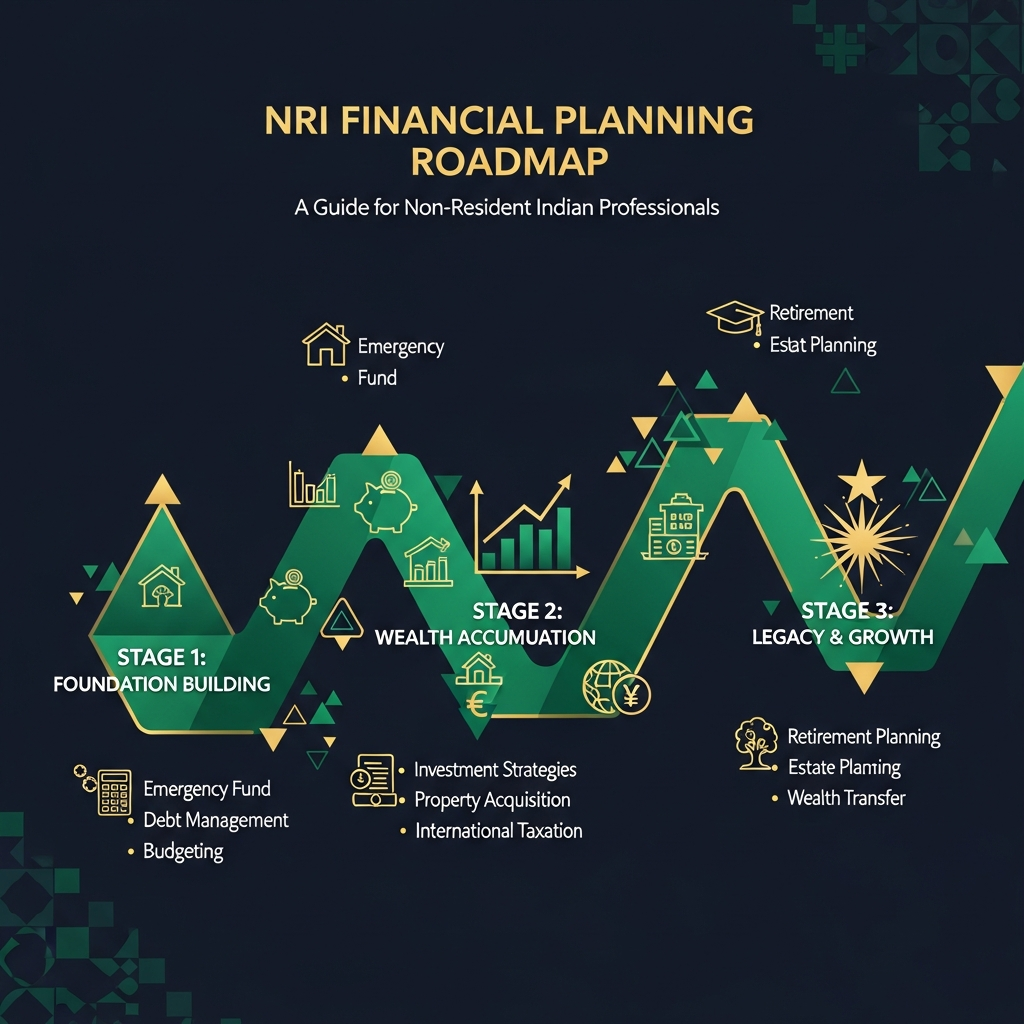
The Three Stages of Wealth Building for NRIs
Over the years I have noticed that most NRI investors move through three stages.
The NRI Wealth Building Journey
Focus on building savings and starting the investment journey. Priorities: discipline, consistent investing, and avoiding expensive products.
Assets grow across mutual funds, global investments, property, and bank deposits. This is where fragmentation begins. Structure and asset allocation become critical.
Focus shifts to risk management, tax efficiency, long term financial independence, and cross-border asset allocation. Portfolio construction becomes more important than individual investment selection.
Most investors move through these stages naturally. The key question is whether the structure around their investments evolves alongside their journey.
The Most Common Mistakes NRIs Make
Many of the portfolios I review follow similar patterns.
- Investors often concentrate too much in Indian assets
- Large amounts are allocated to property or expensive insurance savings plans
- Investments remain scattered across multiple platforms without a unified strategy
We explored these patterns in detail in our article on The Biggest Financial Mistakes NRIs Make.
Avoiding these mistakes alone can significantly improve long term investment outcomes.
The Role of Global Diversification
Many NRI portfolios remain heavily concentrated in India. While India is an important growth market, it represents only a small share of global equity markets.
Global diversification allows investors to participate in companies and industries that may not exist in domestic markets.
For professionals earning in AED, global exposure can also help balance currency risk.
In our guide on Should NRIs Invest More in India or Global Markets, we explore how investors can balance these two worlds effectively.
Exchange Traded Funds are often used as building blocks for global diversification. Our article on How to Build a Global Portfolio Using ETFs explains how these instruments work and why they are widely used in modern portfolio construction.
Key Insight
India represents roughly 4 to 5 percent of global equity market capitalisation. For NRIs earning in AED, having most of the portfolio in one country creates unnecessary concentration in a single economy and currency.
The Math of Financial Independence
Ultimately most financial planning conversations lead to a simple question. How much capital is required to achieve financial independence?
The Math Behind Financial Independence
AED 15,000/month | 5% annual step-up | 8% annual return
Monthly Start
AED 15K
Annual Step-Up
5%
Time
11 yrs
Portfolio Value
AED 3.9 Million
Approximately USD 1 Million
The math behind wealth creation is not complicated. The real challenge is maintaining discipline and building the right portfolio structure.
Our article on How NRIs Can Build a 1 Million Portfolio explains this compounding journey in more detail.
Understanding Your Financial Freedom Gap
One of the first questions we ask investors is simple. What is your Financial Freedom Gap?
This gap represents the distance between where your investments are today and where they need to be to support your desired lifestyle in the future.
Once this gap is understood, every other decision becomes clearer. How much to invest. How investments should grow. How portfolios should be diversified.
The Incentive Problem in Traditional Wealth Management
One of the biggest challenges investors face is misaligned incentives.
Many financial products are sold through commission-based models. This often leads to portfolios filled with high-cost insurance policies, commission-paying mutual funds, and structured products.
In such models, the advisor is compensated for selling products rather than growing the client's wealth.
Commission-Based vs Advisory-Driven
Commission-Based
Advisory-Driven
When incentives are aligned with outcomes, the entire investment experience changes.
At RuDo Wealth we follow a different approach. Our model is advisory driven. Instead of selling products, we focus on building structured portfolios aligned with investor goals.
How RuDo Simplifies Financial Planning for NRIs
Financial planning should not require investors to constantly monitor markets or restructure portfolios.
Our digital and hybrid advisory platforms are designed to simplify this process. Our approach focuses on:
- Goal-based financial planning
- Globally diversified portfolios
- Smart beta strategies
- Multi-asset allocation
- Systematic portfolio monitoring
- Glide path adjustments as investors move closer to their goals
This allows investors to focus on their careers and personal lives while their portfolios remain aligned with their long term financial journey.
Explore Our Planning Tools
Use these calculators to start understanding where you stand on your wealth building journey.
The Bigger Picture
Building wealth as an NRI requires thinking beyond borders.
Income may be earned abroad. Assets may exist across multiple markets. Financial goals may span different currencies and countries.
Financial planning brings structure to this complexity.
With disciplined investing, thoughtful diversification, and aligned advisory support, Indian professionals working in the UAE can build sustainable wealth over time.
Because long term wealth is rarely built by chasing opportunities. It is built by following a structured strategy that evolves alongside life's goals.
Related Reading
- The 10 Biggest Financial Mistakes NRIs Make
- Should NRIs Invest in India or Global Markets?
- How to Build a Global Portfolio Using ETFs
- How NRIs Can Build a 1 Million Dollar Portfolio
- India UAE DTAA Explained
Frequently Asked Questions
What is financial planning for NRIs
Financial planning helps NRI investors structure their savings, investments, and long term financial goals across multiple countries, currencies, and regulatory frameworks.
Should NRIs invest in India or globally
A balanced portfolio often includes exposure to both India and global markets depending on financial goals and risk tolerance. Read more in our India vs Global guide.
What is the Financial Freedom Gap
The Financial Freedom Gap represents the difference between current investments and the amount needed to support future financial independence. Try the Financial Freedom Gap tool to estimate yours.
Why is diversification important for NRIs
Diversification helps reduce concentration risk and allows investors to participate in growth across multiple economies, currencies, and sectors.
Do NRIs need a financial advisor
Many NRI investors benefit from structured advisory support because their investments often span multiple markets, currencies, and regulatory frameworks.
Disclaimer
This article is for educational purposes only and should not be construed as investment advice, a recommendation, or an offer to buy or sell any financial product or security. Investment strategies discussed are based on historical research and may not perform as expected in the future. All investments involve risk including potential loss of capital.
Investment decisions should be made based on individual financial goals, risk tolerance, and professional advice where appropriate. Regulatory and tax considerations may vary depending on jurisdiction.
RuDo Wealth operates under applicable regulatory frameworks in the UAE and India. Investors should consult a qualified financial advisor or tax professional before making investment decisions, particularly when investing across jurisdictions.